Night Blindness: IR From the Datasheet
July 6, 2026 · 2 min read · SiteOps Command
The camera passes at noon and blinds at 2 a.m. — and you find out from the footage, not the design. Night coverage is the failure mode that hides until exactly the moment it matters, and it hides because most designs never model it.
Day coverage is not night coverage
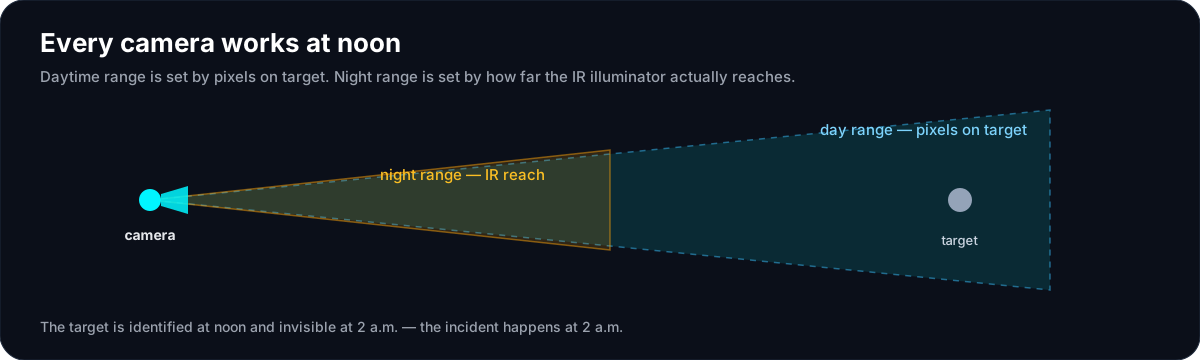
In daylight, a camera’s usable range is set by pixels on target — the DORI question of whether you can detect, recognise, or identify at a given distance (see what DORI actually means). After dark, the range is set by something else entirely: how far the infrared illuminator actually throws, which is the beam angle and rated distance on the datasheet. Those two ranges are not the same, and the night one is usually shorter.
Lux is marketing; the beam spec is physics
A “0.001 lux” line on the datasheet tells you the sensor is sensitive. It does not tell you the infrared reaches the far end of the lot. Night reach is the illuminator’s beam angle and rated distance, applied to the actual scene — a number you can design to, rather than a rating you hope covers the gap.
Where night coverage fails
The usual suspects are predictable once you look for them: long exterior runs where the IR falls off well before the fence; wide areas lit by a single narrow beam; cameras aimed past their rated IR distance; and washout up close, where a too-strong illuminator blows out a face at the door. Each one reads fine on a daytime plan.
Design the dark
Model infrared reach as its own coverage layer, from the datasheet beam specification, so the camera that covers a zone at noon and the camera that covers it at midnight are both verified before the truck rolls. The physics owns the reach; it comes from the illuminator spec and the geometry, not from a hopeful lux number.
A short checklist
- Check night coverage separately from day — it is a different range.
- Use the IR beam angle and rated distance, not the lux figure.
- Watch wide areas served by one narrow IR beam.
- Verify long exterior runs at night, not only on the daytime plan.
- Mind washout up close, not only reach far away.
Every camera works at noon; the incident happens at 2 a.m. To design the dark as carefully as the daylight, see what DORI actually means and why PPF is the floor, the camera design comparison, the security & low-voltage page, or book a demo on your own site.
Frequently asked
- Why does a camera fail at night but not during the day?
- Daytime range is set by pixels on target; night range is set by how far the infrared illuminator reaches. The IR beam angle and rated distance are usually shorter than the daytime usable range, so coverage that passes at noon can fail after dark.
- Is a low-lux rating enough for night coverage?
- No. A low-lux figure describes sensor sensitivity, not how far the IR illuminator throws. Night reach comes from the illuminator's beam angle and rated distance applied to the scene.
- How do you design camera coverage for night?
- Model infrared reach as its own coverage layer using the datasheet beam specification, and verify the night range against each zone separately from the daytime pixels on target.