Fisheye and Panoramic Coverage
July 6, 2026 · 2 min read · SiteOps Command
One fisheye camera in the ceiling can replace four wedges on the wall — but only if you model what it actually sees, and what it sees is not a wedge.
A wedge is a straight-line lie
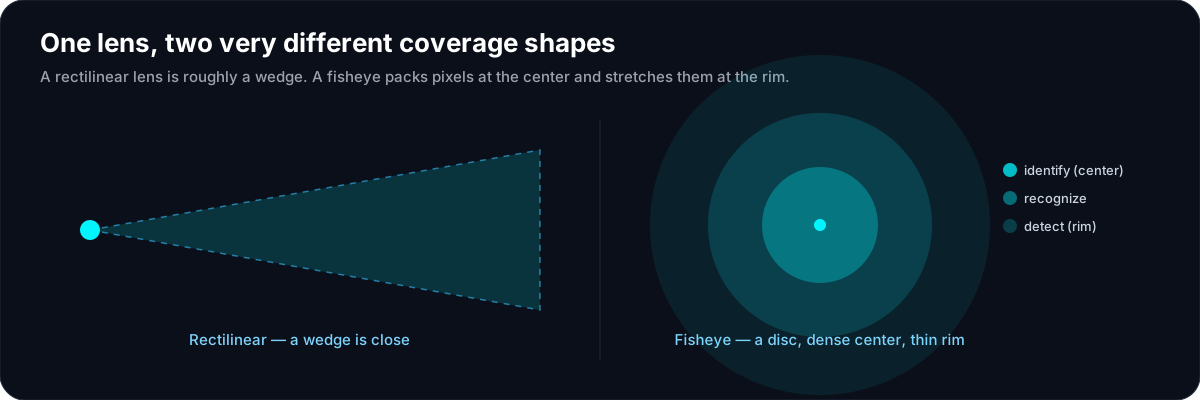
A rectilinear lens projects the scene roughly straight, so a triangle drawn on the plan is a fair approximation of its coverage. A fisheye or panoramic lens does something else entirely: it bends the whole scene onto a round sensor. The coverage is a disc, not a wedge, and the pixels-on-target vary enormously from the middle of that disc to its edge.
Where the pixels go
In a fisheye image the center is dense and the edges are stretched. A person at the rim of the coverage has far fewer pixels on them than a person near the middle — even at the same distance from the camera. Apply one straight-line pixels-per-foot number to the whole disc and it is right almost nowhere: too optimistic at the edge, too pessimistic in the middle.
Model the projection, verify the edges
Estimate coverage with the lens’s actual projection — rectilinear, fisheye, panoramic, or equirectangular — and then check the corners and the rim, where distortion is highest and identification quietly fails. This is the deeper cut of why PPF is the floor, not the ceiling: the wedge is a floor for a straight lens, and it is not even that for a curved one.
One camera, or four?
A 360-degree fisheye covers a room with a single drop and no blind spot behind it — but its identification radius is smaller than its detection radius, so it may recognise everyone in the room and identify no one at the door. A set of narrower cameras trades coverage area for pixels on target. The right call is not a rule of thumb; it is the one you can see on the model, per zone, before you mount anything.
A short checklist
- Model fisheye and panoramic cameras by their projection, not a wedge.
- Check the rim and the corners, where pixels are thinnest.
- Separate the detect radius from the identify radius.
- Decide one wide camera versus several narrow ones on the model, per zone.
A fisheye that detects everyone in the room may identify no one at the door — and only the projection tells you which. See what DORI actually means and night reach from the datasheet, the camera design comparison, the security & low-voltage page, or book a demo on your own site.
Frequently asked
- Can you use a triangular coverage wedge for a fisheye camera?
- No. A fisheye or panoramic lens does not project in straight lines, so a triangular wedge overstates the center and understates the edges. Those lenses need their actual projection model to estimate usable coverage.
- How many pixels does a fisheye camera put on a target?
- It depends on where the target is in the image. Fisheye projection packs pixels near the center and stretches them at the edges, so a person at the rim has far fewer pixels than one near the middle at the same distance.
- Is one 360-degree camera better than several narrow cameras?
- It depends on the goal. A single fisheye covers a room with no blind spot behind it, but its identification radius is smaller than its detection radius. Narrower cameras trade coverage area for pixels on target. Model both before deciding.