PPF Is the Floor, Not the Ceiling
July 5, 2026 · 3 min read · SiteOps Command
A pixels-per-foot calculator gives you a clean triangle on a flat floor plan. It is a useful floor to start from — and it quietly stops being true the moment the building, the lens, or the dark gets involved.
PPF earns its place
Start with the credit it deserves. Pixels-per-foot (the imperial cousin of DORI’s px/m — see what DORI actually means) is a fast, honest sanity check: for a given sensor, lens, and distance, roughly how many pixels land on the target? That single question rules out a lot of bad mounts in seconds, and every designer should be able to answer it in their head.
The trouble starts when the wedge on the plan is treated as the coverage, rather than as the best case on a frictionless day.
Where the wedge stops being true
1. It assumes a straight-line lens. Fisheye and panoramic cameras do not project in straight lines. A triangular wedge overstates the centre of the image and understates the edges, so you end up specifying corners you cannot actually resolve — or buying a second camera you did not need. Model the real projection (rectilinear, fisheye, panoramic, equirectangular) or the numbers are fiction past a few degrees off-axis.
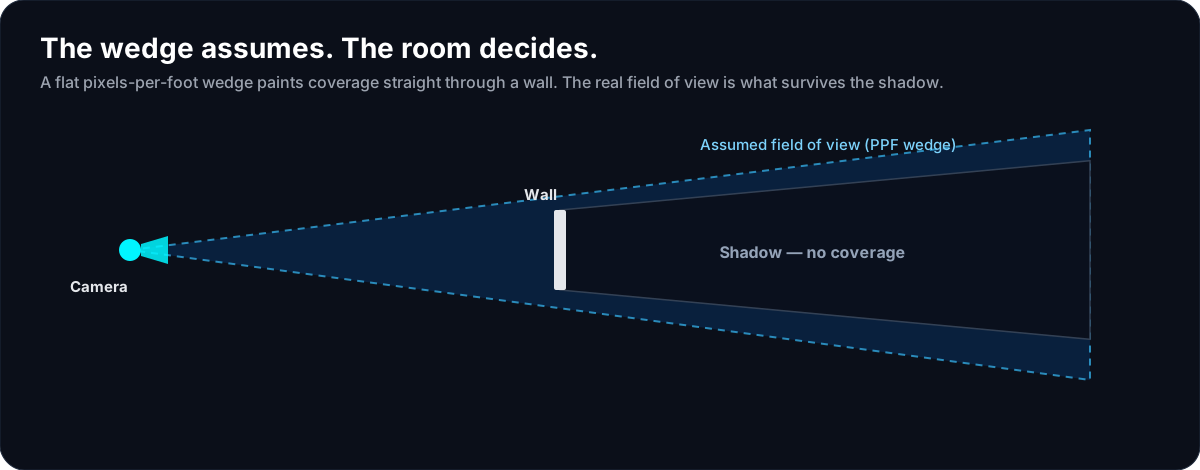
2. It ignores occlusion. Walls, glass, and — worst of all — warehouse racking block line of sight. A flat wedge paints coverage straight through a 20-foot steel rack; the real field of view is only what survives the shadow.
Glass is its own trap: transparent to the eye, but an oblique, reflective surface that does not behave like the drywall beside it. A model that treats every wall the same will place cameras that see a reflection of the room they are standing in.
3. It is blind at night. Daytime PPF says nothing about whether the infrared illuminator reaches the target. Night reach comes from the datasheet beam angle and range. A camera can pass at noon and go dark exactly when the incident happens — and you find out from the footage, not the design.
4. It is one number for the whole site. Coverage requirements are per zone. A single global PPF under-covers the dock and over-specs the hallway, which is the same failure DORI exists to prevent.
What right looks like
Honest camera coverage keeps the PPF instinct and adds the physics the wedge leaves out:
- Per-zone density targets (DORI / IEC 62676-4), so each area is designed for what it is for.
- Real lens projection, so fisheye and multi-sensor cameras are estimated by their geometry, not a wedge.
- Shadow-cast fields of view, so walls, glass, and racking remove the coverage they actually block.
- Infrared reach from the datasheet, so night is designed, not assumed.
The output is a coverage heatmap and a per-camera point of view the customer can stand under and verify. The physics owns every number; SiteOps Command computes it and shows its work. See the method on the coverage physics page.
A short field checklist
- Use PPF for a quick distance sanity check, then verify against the actual room.
- For fisheye and multi-sensor cameras, check the corners and the projection, not only the centre.
- Draw walls, glass, and racking as obstacles, and read the field of view that survives.
- Verify infrared range for every camera that has to work at night.
- Set the density target per zone, not once for the site.
- Give the customer a point-of-view they can confirm on site.
PPF is where a good design starts. It is not where a defensible one ends. To see the full camera picture — projection, occlusion, night, and per-zone density — read the camera design comparison, the security & low-voltage page, or book a demo on your own floor plan.
Frequently asked
- Is pixels-per-foot (PPF) accurate?
- PPF is a good first estimate of pixel density at a distance, but it assumes a straight-line lens on a flat plan. It does not account for fisheye or panoramic projection, occlusion from walls and racking, or night-time infrared reach — the factors that decide real coverage.
- Why does a PPF wedge not work for fisheye cameras?
- Fisheye and panoramic lenses do not project in straight lines, so a triangular wedge overstates the centre of the image and understates the edges. Those lenses need their actual projection model to estimate usable coverage.
- What does a free camera calculator usually miss?
- Typically lens projection beyond rectilinear, occlusion from walls, glass, and racking, night infrared range from the datasheet, and per-zone density targets. It is a fast floor, not a coverage guarantee.