Features · Project lifecycle
One model runs the job — discovery to renewal.
Requirements, design, BOM, scope, install, as-built, renewal: seven stages that usually mean seven re-keyings across seven tools. Here they read one canonical model, and the deliverables derive from it.
The through-line
- 01 Requirements classified answers become design targets
- 02 Design the model — floors, zones, devices, physics
- 03 BOM derived from the design, not retyped
- 04 Scope & labor grounded in BICSI TDMM and RS Means
- 05 Install field ops with photo verification
- 06 As-built generated from the model and evidence
- 07 Renewal spawns the next discovery automatically
Each stage reads the last one's output. No re-entry.
Stage 1 · Requirements
Discovery that compiles into the design
In most shops, discovery is a questionnaire in one tool and a memory in the rest. Here it is a structured engine: adaptive question packs across the disciplines, with every answer classified and carried forward.
- Adaptive packs ask what a senior engineer would ask — with follow-up questions triggered by your answers, across cameras, wireless, cabling, and the rest of the job.
- Every entry is classified — fact, assumption, inference, recommendation, or unresolved risk — so the whole team knows which statements are load-bearing.
- Answers drive the design: camera objectives become per-zone pixels-on-target targets the placement engine must meet.
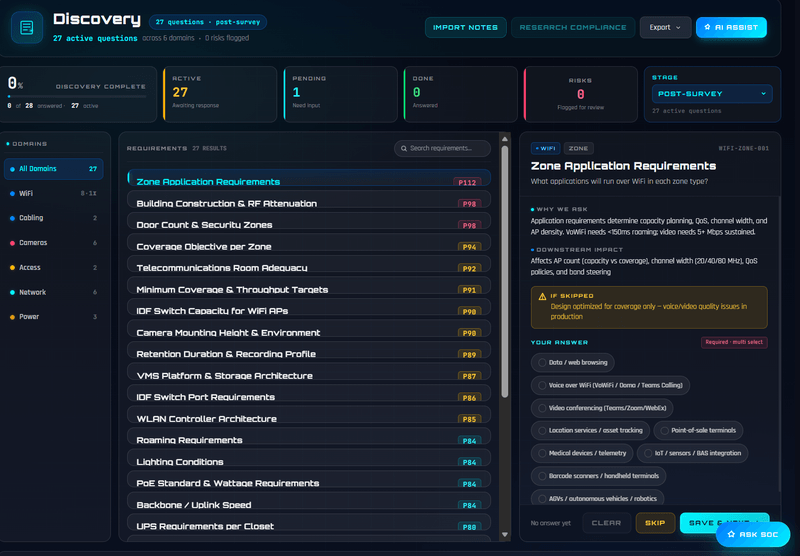
A requirement, classified
- Fact
- confirmed with the customer
- Assumption
- stated, awaiting confirmation
- Inference
- derived — shown with its source
- Recommendation
- the suggested position
- Unresolved risk
- flagged until someone owns it
Classification travels into every deliverable that quotes it.
Stages 2–4 · Design, BOM, scope
Derived, not retyped
The documents that decide the money derive from the model. The bill of materials is computed from what is actually placed; labor is grounded in industry productivity data; the scope document reads from the same design.
- A deterministic pipeline turns the design into the BOM — devices, cabling, switching, power budgets, storage, licensing — with accessories that follow product rules.
- Labor estimates grounded in BICSI TDMM and RS Means productivity data, derived from device counts and design complexity — feeding quotes you can defend line by line.
- Technical scope-of-work documents assemble from the same design, with presets your org saves and reuses.
- Change the design and re-derive — the documents follow the model, never the other way around.
What the BOM already knows
- Devices
- every placed product, by part
- Cabling
- run lengths from the plan scale
- Switching & PoE
- ports and power budgets from the loads
- Storage
- camera retention math
- Licensing
- what the gear needs to run
Derived from the design. Zero retyping.
Stages 5–6 · Install & as-built
Install against the design, not from memory
The field crew works from the same model: plans on their phones, installs tracked device by device, photos verified against the design view.
- A mobile-first field surface — floor plans, task lists, and device installs, built for phones and tablets on site.
- Photo verification pairs the design view with the installed reality, device by device.
- One canonical quality record: punch items, acceptance exceptions, signoffs, and milestone gates are one object with one history — not four systems that disagree.
- The as-built generates from the model and the install evidence — sheets, schedules, and design-vs-installed photo pairs.
Closing out a device
- 01 Install it from the plan in hand
- 02 Photograph it evidence attached to the device
- 03 Verify it against the design view
- 04 It lands in the as-built automatically, with the pair
Stage 7 · Renewal
The renewal is the next project's discovery
Most tools end at the invoice. Here the commercial spine — renewals, orders, invoices, receivables — runs on the same platform, and a renewal automatically opens the next discovery session with everything the last project learned.
- A renewal pipeline with status workflow — no renewal lost to a forgotten date.
- Creating a renewal spawns a pre-quote requirements session automatically — the loop closes itself.
- The as-built and install history are the starting truth for the next design — not a PDF someone has to go find.
The loop, closing
- 01 Renewal created date, value, and status tracked
- 02 Discovery opens a pre-quote session, automatically
- 03 Last model is right there as-built truth, not tribal memory
- 04 The next job starts already ahead of the RFP
What "one model" buys you
- One model
- From first question to renewal
- Requirements, design, money, and field work read the same record
- Derived, not retyped
- BOM · labor · scope · as-built
- The documents follow the model — not the other way around
- 5 classifications
- On every requirement
- Fact · assumption · inference · recommendation · unresolved risk
- Renewal → discovery
- The loop closes automatically
- A renewal opens the next requirements session on its own
Frequently asked questions
Is this a project-management tool?
It carries the workflow — phases, tasks, field operations — but the difference is what the workflow runs on. In a PM tool you describe the job; here the job is a model, and the BOM, labor, scope, and as-built derive from it instead of being retyped into it.
What happens when the design changes mid-project?
You change the model and re-derive. The bill of materials recomputes from what is actually placed, labor and scope read the new design, and the differences surface for review instead of hiding in a stale spreadsheet.
Do field technicians work in the same system?
Yes — a mobile-first surface with the plans, their tasks, and photo capture, built for phones and tablets on site. Verification photos pair with the design view, so the as-built assembles itself from evidence rather than memory.
Where does the renewal fit?
Renewals, orders, invoices, and receivables run on the same platform, linked to the same customers and projects. When a renewal is created, the platform opens a pre-quote discovery session automatically — the last project's model is the starting point for the next one.
Run the whole job on one model
From the first discovery question to the renewal that starts the next one. Talk to us about what your team needs.