Glass Is Not a Wall
July 6, 2026 · 2 min read · SiteOps Command
A pane of glass is the one obstacle that fools two disciplines at once — and it fools them in opposite directions. Treat it like the wall next to it and you will be wrong about the Wi-Fi and wrong about the cameras, in ways that cancel out on the plan and show up on site.
To Wi-Fi, glass is nearly a window
Radio passes through glass with modest loss — far less than the drywall beside it, and nothing like the concrete. A predictive model that treats a glass partition as a solid wall paints a dead zone on the far side that is not actually there, and you end up adding an access point to cover a space that was already covered.
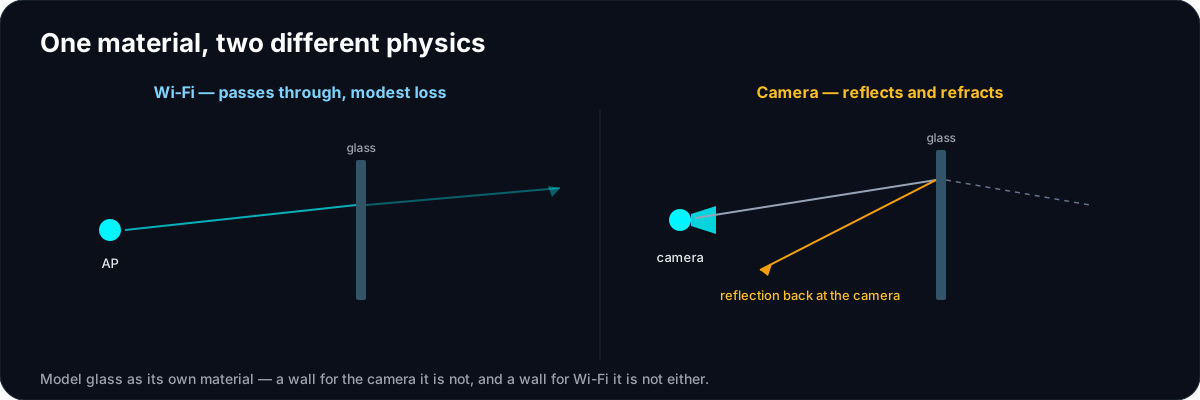
To a camera, glass is a mirror and a lens
Point a camera at or through glass and the physics goes the other way. The surface reflects — the camera sees the lit room it is standing in — and it refracts, so the scene beyond bends and dims. A camera modeled as if glass were open air is credited with a view it does not actually have, and the blind spot is discovered the first time someone walks the footage.
Same pane, opposite errors
Treat every wall the same and you get both wrong at once: the Wi-Fi model blocks a signal that passes, and the camera model passes a view that is blocked. The errors point in opposite directions, so a design that looks balanced on paper is doubly wrong in the atrium.
What right looks like
The obstacle model has to carry glass as its own material — low RF loss for propagation, reflective and refractive for optics — so the Wi-Fi heatmap and the camera field of view each get the physics that applies to them. It is the same reason the obstacle model matters as much as the camera math: the field of view is only as honest as the materials in the way.
A short checklist
- Model glass as its own material, not a wall.
- For Wi-Fi, expect modest loss, not a hard block.
- For cameras, watch for reflection and refraction through glass.
- Verify atriums and glass-walled rooms on both disciplines.
The atrium that looks fully covered on Wi-Fi and fully watched on camera may be neither. See what DORI actually means and fisheye and panoramic coverage, the coverage physics page, the camera design comparison, or book a demo on your own building.
Frequently asked
- Does glass block Wi-Fi?
- Not much. Glass attenuates Wi-Fi far less than drywall or concrete; radio passes through with modest loss. Modeling glass as a solid wall invents dead zones that do not exist.
- Can a camera see through glass?
- Partly, and unreliably. Glass reflects and refracts, so a camera aimed at or through it can see a reflection of its own side and a dimmed, bent view of the scene beyond. Glass has to be modeled as its own optical surface, not open air.
- Why model glass separately from walls?
- Because it behaves oppositely for radio and for optics: nearly transparent to Wi-Fi, reflective and refractive to cameras. One material with two different physics needs its own model in each discipline.