Why Conference-Room Audio Fails
July 6, 2026 · 2 min read · SiteOps Command
When the far end cannot follow the meeting, the microphone gets the blame. The room is usually at fault — and no microphone fixes a room that smears speech.
Speech has to survive the room
Every hard surface reflects sound. The reflections arrive a beat late and pile onto the original speech, blurring the consonants that carry meaning. Reverberation time — RT60 — measures how long they linger. The longer they linger, the lower the speech intelligibility, the number the standard — IEC 60268-16 — calls STI.
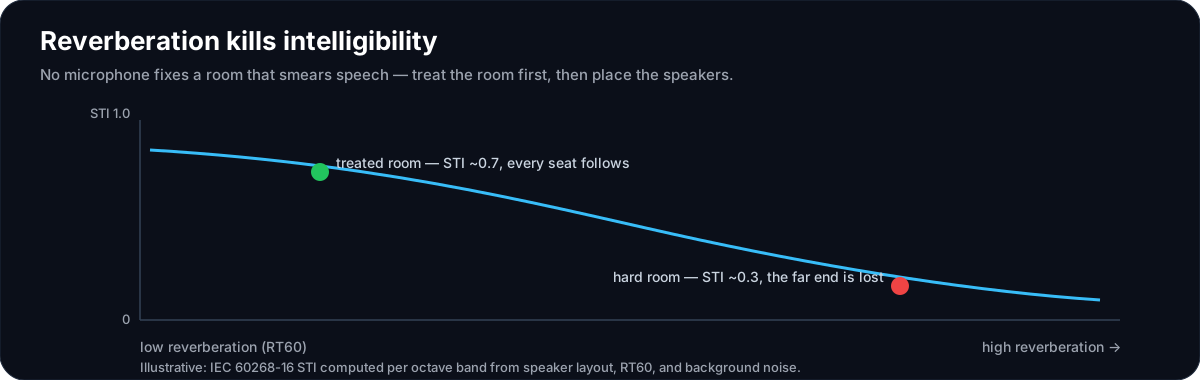
No microphone fixes a bad room
A better microphone raises the signal; it does not remove the reflections that are smearing it. In a hard, reverberant room, STI can fall toward 0.3 — where words blur regardless of what mic you hang. Treating the room, with soft surfaces and the right speaker placement, is what raises it back toward 0.7, where every seat can be understood.
Background noise stacks on top
HVAC, corridor noise, and the projector fan all pull STI down further, and an omnidirectional microphone takes in every bit of it. This is where the microphone choice does matter: a cardioid or beamforming pattern rejects the noise the room and its neighbours add. (Scoring all of this per seat is covered in conference AV, scored by the standard.)
Design the room, then the system
Compute STI per seat from the speaker layout, the room’s reverberation per octave band, and the background noise — before the install. The room that sounds fine to one person in the doorway is the room the far end cannot follow when it is full, and a per-seat number shows that gap while it is still a design.
A short checklist
- Treat the room before you choose the microphone.
- Compute STI per seat, not an average for the room.
- Match the microphone pattern to where the noise is.
- Check the room full, not empty.
Good conference audio is a room problem before it is a product problem. See how it is scored by the standard, the conference AV page, or the integrator workflow; or book a demo to score a room on your own plan.
Frequently asked
- Why does conference-room audio sound bad even with good microphones?
- Because the room, not the microphone, is usually the problem. Hard surfaces reflect sound; the late reflections smear speech and lower intelligibility (STI). A better microphone raises the signal but does not remove the reflections.
- What is RT60?
- Reverberation time: how long sound lingers in a room as it decays. Longer reverberation smears speech and drops the speech transmission index (STI). Softer surfaces and better speaker placement shorten it.
- How do you fix a bad-sounding meeting room?
- Treat the room first to reduce reverberation and background noise, then place speakers for intelligibility at the far seats and choose a microphone pattern that rejects the room's noise. Compute STI per seat before the install to catch the seats that fail.