Conference AV, Scored by the Standard
July 5, 2026 · 3 min read · SiteOps Command
“It sounds fine in here” is not a spec. A room either lets the far end understand every seat, or it does not — and you can compute which before you hang a single speaker.
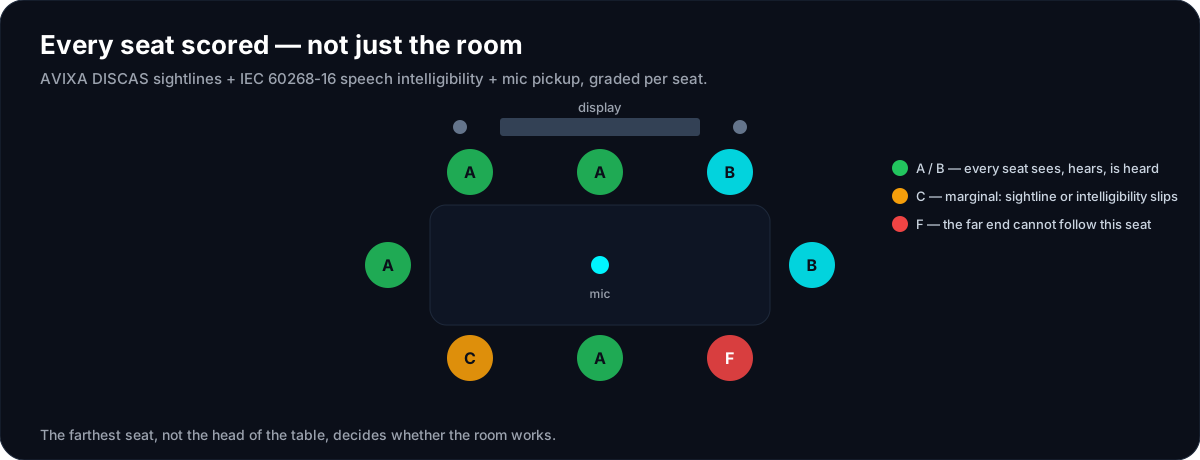
Conference-room AV has standards for each of the three things a meeting needs: to be seen, to be heard, and to be picked up. Score all three, per seat, and the two seats that fail show up on the plan instead of in the first all-hands.
See it — AVIXA DISCAS
DISCAS (Display Image Size for 2D Content in Audiovisual Systems) sizes the display against the room: the farthest viewer must still resolve the content, given the viewing distance and the off-axis angle. A screen that reads fine from the head of the table can be unreadable from the back corner. Scoring each seat against DISCAS turns “big enough” into a number.
Hear it — IEC 60268-16 STI
Speech Transmission Index measures how much of the talker survives the room. It is computed from the speaker layout, the room reverberation (RT60) per octave band, and the background noise. A live, hard-surfaced room drops STI sharply — and no microphone fixes a room that smears speech. Treat the room first; then place the speakers where intelligibility holds at the far seats, not only under the array.
Be heard — microphone polar patterns
Getting the room to hear the talker is the mirror image. An omnidirectional mic takes in HVAC and side conversation from every direction; a cardioid, supercardioid, or beamforming mic rejects the rear and sides, lifting the signal above the noise. The right pattern depends on where the noise is, which is a property of the room — not a line on the datasheet.
The composite — a grade per seat, a grade per room
Put them together — display sightline, speech intelligibility, microphone pickup, and camera framing — and each seat earns a grade, and the room earns the worst of them. That is the point: the room that “sounds fine” when you walk in alone is the room the far end cannot follow when it is full. A per-seat grade shows the failure while it is still a design, not a callback.
The physics owns every score; SiteOps Command computes it from the speaker, the mic, the room, and the seats, and grades each one. See the method on the conference AV page.
A short checklist
- Score the farthest seat, not the head of the table.
- Fix the room (RT60) before you add microphones.
- Match the mic polar pattern to where the noise actually is.
- Check camera framing per seat, not only the wide shot.
- Grade every seat — one failing seat is a failed meeting.
Conference AV is one discipline of a larger install, and it runs on the same model that places the cameras and designs the Wi-Fi — see the cost of running it as six separate tools, the integrator workflow, or book a demo to score a room on your own plan.
Frequently asked
- What standards define good conference-room AV?
- AVIXA DISCAS for display sizing and viewing angles, IEC 60268-16 STI for speech intelligibility, and microphone polar-pattern behavior for pickup. Together they score sightline, sound, and being heard for each seat.
- What is a good STI score?
- STI runs from 0 to 1, higher is better. Room reverberation and background noise pull it down: a live, hard room can fall toward 0.3 where a treated room holds around 0.7. The speaker layout and room treatment matter more than the microphone.
- Does the microphone polar pattern matter?
- Yes. Omnidirectional mics pick up noise from every direction; cardioid, supercardioid, and beamforming mics reject side and rear noise, improving the signal in a noisy room. Match the pattern to the room, not to the spec sheet.