The Physics of an Honest Wi-Fi Heatmap
July 5, 2026 · 3 min read · SiteOps Command
Two tools can both call themselves predictive, open the same floor plan, and draw very different heatmaps. The difference is not the colours. It is whether the number under each pixel came from a physical model or from a fixed-radius bubble.
Predictive Wi-Fi has a set of standards for exactly this. Three of them do most of the work.
Three standards, three jobs
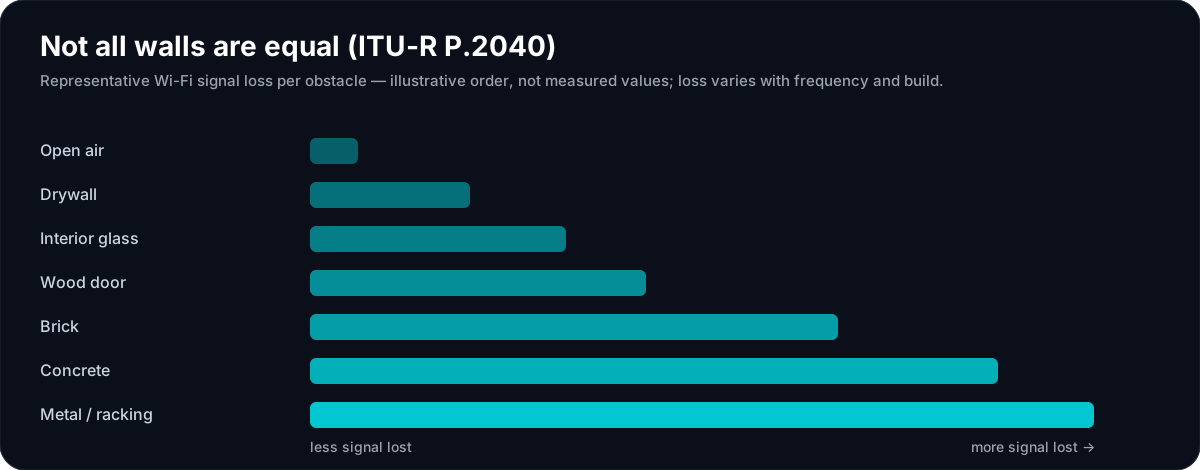
ITU-R P.2040 — what the walls are made of. A wall is not a wall. P.2040 models each material by its complex permittivity, with TE/TM Fresnel reflection at every surface, so drywall, glass, brick, and concrete attenuate very differently. Get the material wrong and the heatmap is confidently wrong.
ITU-R P.526 — how signal bends. Radio does not stop dead at an obstacle; it diffracts around edges. P.526 covers knife-edge and multiple-edge (Deygout) diffraction and Fresnel-zone clearance, so the model knows a signal bends into the space behind a partial blocker instead of leaving a hard black shadow. A model without diffraction paints dead zones that are not actually dead — and misses the ones that are.
ITU-R P.1238 — the statistical fallback. You cannot always enumerate every wall in a messy building. P.1238 gives an indoor path-loss exponent per environment type — a statistical decay that captures the aggregate clutter an office or a warehouse adds without drawing each partition.
Why one model is not enough
Discrete wall-by-wall modelling is excellent in a clean office with known partitions and nearly useless in a 200,000-square-foot warehouse full of racking you cannot fully enumerate. The statistical model is the reverse. Pick either one alone and half your buildings come out wrong.
The honest move is to compute both and take the more conservative answer, so sparse offices and dense warehouses both come out defensible. Around that, the model still has to respect:
- Measured vendor antenna patterns, not idealized doughnuts — real APs radiate unevenly.
- Per-zone RF parameters — the environment exponent and noise floor of a warehouse are not those of a conference room.
- Warehouse racking attenuation aware of depth, angle of incidence, and height — the aisle that looks green over the top of a rack can be dead at pick height.
- Uplink and downlink asymmetry — the phone talks back weaker than the AP talks down, and a heatmap that only models the downlink oversells the edges.
A “3 dB per 10 feet” rule of thumb, or a fixed-radius coverage circle, is a guess wearing a lab coat. It looks fine on the proposal and fails at the far corner of the warehouse.
This is why the number matters more than the picture. SiteOps Command never invents a propagation figure — the RF engine computes it from materials, geometry, diffraction, and measured patterns, takes the conservative of the discrete and statistical models, and shows the model it used. See the method on the coverage physics page.
A short field checklist
- Give every wall a material, not only a line — the material is the physics.
- Treat glass as its own material, not “a wall.”
- Do not let racking be empty space; model its depth and angle.
- Design to the conservative of the discrete and statistical models.
- Check the uplink, not only the AP downlink.
- Validate on site where the stakes are highest — a good model narrows where you need to walk.
A heatmap is a claim about a building you have not covered yet. Make it a claim the physics can back. For the deeper story, see predictive vs. measured surveys and a Wi-Fi heatmap without Ekahau; for how it maps to a workflow, the Ekahau comparison and the MSP page. To try it on your own plan, book a demo.
Frequently asked
- What Wi-Fi propagation standards does a good predictive model use?
- ITU-R P.2040 for material permittivity and reflection, P.526 for knife-edge and multiple-edge diffraction and Fresnel-zone clearance, and P.1238 for statistical indoor path loss. A strong model combines the discrete wall-by-wall and statistical approaches rather than picking one.
- Why do two predictive Wi-Fi tools disagree on the same building?
- Usually because they model the physics differently: wall materials, diffraction, reflections, antenna patterns, and whether they use a discrete, statistical, or combined path-loss model. Two predictive heatmaps are only as comparable as the physics underneath them.
- Is a fixed-radius coverage circle good enough for design?
- No. A fixed radius ignores wall materials, diffraction, racking, and antenna patterns. It can look reasonable on a plan and badly overstate coverage where materials or distance work against you.