Cable Paths by Physics
July 6, 2026 · 2 min read · SiteOps Command
The cable length on the bill of materials is usually a straight line on the plan times a number someone made up. The pull does not care about that number — and neither does the reel when it runs out twenty feet short.
Length is a route, not a line
A cable does not fly from the device to the closet. It runs along pathways, turns corners, drops vertically, and keeps a service loop at each end. The real length is the route, and a straight-line estimate is short in exactly the ways that matter: the drop you forgot, the detour around the duct, the loop the next technician needs.
Tension climbs at every bend
Pulling cable is physics. Tension builds along the run and multiplies at every bend — the capstan effect — so a route with several turns can exceed the cable’s rated pull tension long before it exceeds its rated length.
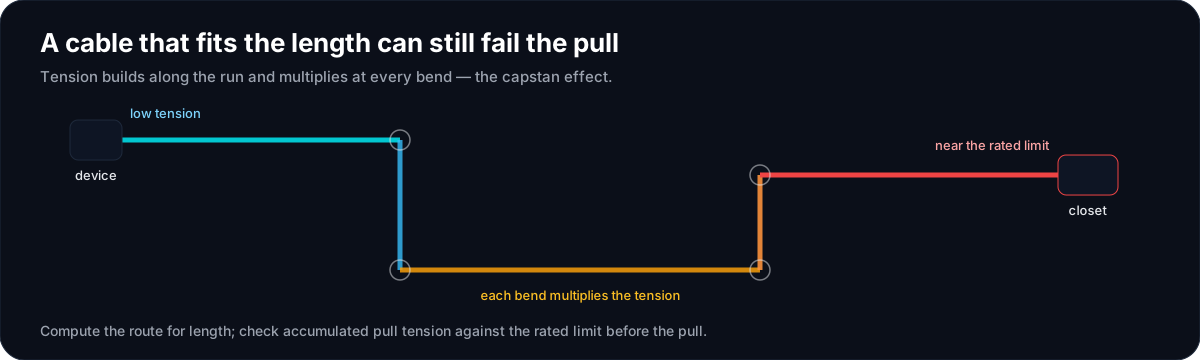
A path that fits on the plan can still be a pull that damages the cable, or one the crew cannot finish — and you find out in the ceiling, not on the drawing.
Compute the route, respect the limits
The honest way is to compute the actual route — pathways, drops, service loops — for the length, and check the accumulated pull tension against the rated limit, so the bill of materials is right and the pull is possible. It is the same principle as the coverage physics: the number comes from the geometry, not a fudge factor.
Why it lands on the BOM
Get the route wrong and two things break at once. You buy the wrong footage — short, or wastefully long — and the install hits a pull the route cannot support. Both are far cheaper to catch on the model than in the ceiling, which is the whole reason your BOM is the design: the cable schedule is a projection of the real route, not a guess laid over it.
A short checklist
- Take cable length from the real route, not a straight line.
- Include the vertical drops and a service loop at each end.
- Check accumulated pull tension against the rated limit.
- Reroute to reduce bends before the pull, not during it.
A cable that fits the length can still fail the pull. See the SOW & BOM and project lifecycle pages, the integrator workflow, or book a demo on your own plan.
Frequently asked
- How do you calculate cable length for a run?
- From the actual route: along the pathways, around corners, down the vertical drops, plus a service loop at each end — not a straight-line distance times a fudge factor. The route decides the footage you buy.
- What is pull tension and why does it matter?
- The force needed to pull a cable through its pathway. It builds along the run and multiplies at every bend, and exceeding the cable's rated pull tension can damage it. A route can be short enough on length and still fail on tension.
- What is the capstan effect in cabling?
- The way friction multiplies tension around a bend: each turn in the pathway increases the force at the puller, so several bends compound quickly. It is why a route with many corners can exceed the cable's pull limit.